I chose you from the world, to go and bear fruit that will last, says the Lord.
(Jo 15: 16)
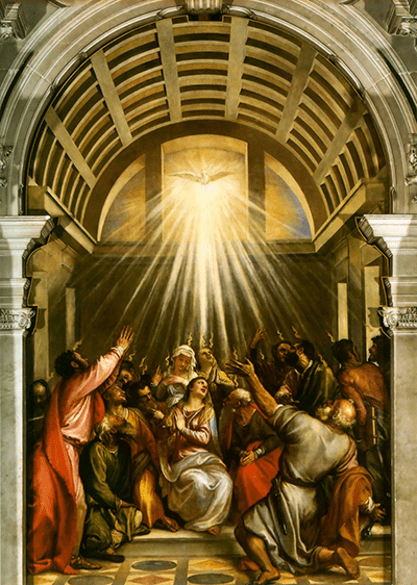
Pentecost by Titian1
Last Sunday we celebrated the culmen of the Catholic Easter liturgy, that is, the Solemnity of Pentecost. Christ breathed the Holy Spirit into the nascent Church. Pentecost is the celebration of a new creation, which takes place as a tempestuous wind, that is, the love of God, his Holy Spirit. Our Lord wanted his disciples to run the Church and gave them the gift of peace and the gift of forgiving sins.
Pray
Today’s verse before the gospel is a reminder that we are called and sent to bear fruit. And it is connected to today’s gospel: we cannot have peace, neither can we bear fruit, without prayer.
Therefore I tell you, all that you ask for in prayer, believe that you will receive it and it shall be yours. When you stand to pray, forgive anyone against whom you have a grievance, so that your heavenly Father may in turn forgive you your transgressions.
Prayer is like the air to our soul. The same way the air quality affects our lungs, so does the quality of our prayer. Aquinas spoke of the five excellent qualities required for prayer indicating that it must be confident, suitable, ordered, devout and humble. Going through these qualities is an excellent test to examine the quality of our prayer life.
Qualities
It must be confident, Aquinas says, knowing that we have an Advocate with the Father, the Spirit that Christ has just sent, again, to the Church. He quotes Saint Cyprian: “Since we have Christ as our Advocate with the Father for our sins, when we pray on account of our faults, we use the very words of our Advocate.”
Our prayer must be suitable, so as to ask what is good for us. St. John Damascene says: “Prayer is the asking of what is right and fitting from God.” Christ Himself is our Teacher; it is He who teaches us what we ought to pray for, and it was to Him that the disciples said: “Lord, teach us to pray.”
Our prayer ought also to be ordered as our desires should be ordered, for prayer is but the expression of desire. “Seek ye first therefore the kingdom of God and His justice, and all these things shall be added unto you.”
Our prayer must be devout, because a rich measure of piety makes the sacrifice of prayer acceptable to God. Often, because of the length of our prayers, our devotion grows cold; hence, Our Lord taught us to avoid wordiness in our prayers: “When you are praying, speak not much.” For this reason, the Lord made His Prayer short. Devotion in prayer rises from charity, which is our love of God and neighbor, both of which are evident in this prayer. Our love for God is seen in that we call God “Our Father”, and our love for our neighbor when we say: “Our Father… forgive us our trespasses,” and this leads us to love of neighbor.
Prayer ought to be humble. This is seen in the parable of the Pharisee and the Publican and also in the words of Judith: “The prayer of the humble and the meek hath always pleased Thee.”
Fruits of Prayer
And what are the fruits of prayer? First, prayer is an efficacious and useful remedy against evils. Second, prayer is efficacious and useful to obtain all that we desire: “All things whatsoever you ask when you pray, believe that you shall receive.” Thirdly, prayer is profitable because it makes us friends of God: “Let my prayer be directed as incense in Thy sight.”2
Dear brothers and sisters, may our Lord continue to breathe his Holy Spirit into our souls and inspire us to pray well so that we can bear fruit.
God bless you all,
Fr. Marcelo Javier Navarro Muñoz, IVE
Author: The Contribution of Cornelio Fabro to Fundamental Theology. Reason and Faith, Cambridge Scholars Publishing: https://www.cambridgescholars.com/product/978-1-5275-9315-2 Poesía Sacra, Quemar las Naves, and Desde Fossanova, IVE Press: https://ivepress.org/
1 https://www.thehistoryofart.org/titian/pentecost/, accessed May 26, 2026.
2 Taken from https://isidore.co/aquinas/english/PaterNoster.htm, accessed May 24, 2026.