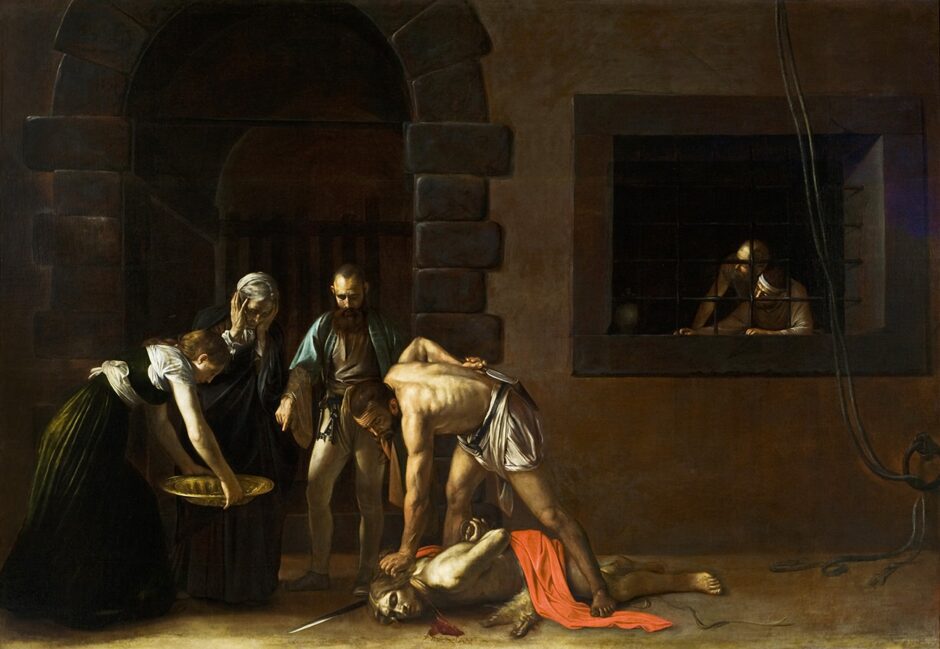
The Decapitation of Saint John the Baptist, 1607 by Caravaggio[1]
Once again, the Church presents to us the liturgical memorial of the Passion of St John the Baptist. Once again, I face the same main thought that comes to my mind when I read this gospel. It is a display of human cruelty. Obviously, hatred and cruelty seem to have concentrated at the Cross of our Lord, but the human, rather inhuman, aspect of cruelty taken to its extreme appears – at least to me – in the words of Herodias and the request of her daughter. Can you imagine being present at that banquet where, all of a sudden, someone’s head will enter the hall on a plate…? Laughter…? Hatred…? Vengeance…? Repulsion…? Sadness…? How about you, King Herod, your concubine and her daughter…? Will life continue as if nothing, absolutely nothing, happened? Point is, obviously the king’s conscience which is God’s voice in every human being, has corrupted and died long ago…
A Horrific Act
“‘I will grant you whatever you ask of me, even to half of my kingdom.’ She went out and said to her mother, ‘What shall I ask for?’ She replied, ‘The head of John the Baptist’.” We have heard this gospel so many times that we risk reading it superficially. Can you imagine having this dialogue, or even listening to it? What a mother! What a daughter! What a “husband”! And, an executioner goes about doing his “job”… It is simple, I will behead someone, no big deal, and will be back in a minute. No problem.
I do not know about you, but I have trouble reading this passage and not being shaken. Yes, I know that those who are persecuted for the sake of righteousness are blessed and,
they will inherit the Kingdom of heaven. I do believe that, and have no theological objections to it. Still, “my frame” shakes…
This always reminds me of a line from a friend of mine, Tom Hiney¾from his book The Song of Ascents. Lives of Rage and Stillness (Ignatius) ¾converted from Anglicanism, and today a Catholic priest. He wondered how to explain to his fourteen-year old son “fourteen hundred pages of love and brutality”, that is the Bible. To explain love in the Scriptures comes more naturally but to explain a display of brutality and hatred as this passage, first towards our Lord, then towards his followers, takes better skills and more theology, and the grace of faith.
Thank the Martyrs
I can go on, but I will avoid it. As we celebrate today’s memorial let us thank the martyrs as John the Baptist, who were able to offer their lives not only for what they believed but for Whom they believe in and loved, our Lord, the Lamb of God as the Baptist had described his Savior. Let us thank God for the gift of a good conscience, one the most intimate forms of his divine presence in us.
May the Lord bless you all,
Fr. Marcelo Javier Navarro Muñoz, IVE
Author: The Contribution of Cornelio Fabro to Fundamental Theology. Reason and Faith, Cambridge Scholars Publishing: https://www.cambridgescholars.com/product/978-1-5275-9315-2
Poesía Sacra, Quemar las Naves, and Desde Fossanova, IVE Press: https://ivepress.org/
[1] From https://www.caravaggio.org/the-decapitation-of-saint-john-the-baptist.jsp, accessed 24 August 2026.