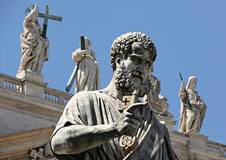
Statue of St Peter the Apostle[1]
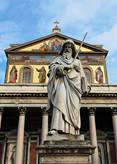
Statue of St Paul the Apostle[2]
Dear brothers and sisters: Mother Church celebrates today the Solemnity of these two great Apostles. I would like to share with you some brief excerpts from the Catecheses of Pope Benedict XVI on Peter and Paul.
Regarding the vocation of Peter Benedict XVI wrote that “the conversions of St Peter on different occasions … are a great consolation and a great lesson for us. We too have a desire for God, we too want to be generous, but we too expect God to be strong in the world and to transform the world on the spot, according to our ideas and the needs that we perceive.
He Shows Us the Way
God chooses a different way. God chooses the way of the transformation of hearts in suffering and in humility. And we, like Peter, must convert, over and over again. We must follow Jesus and not go before him: it is he who shows us the way.
So it is that Peter tells us: You think you have the recipe and that it is up to you to transform Christianity, but it is the Lord who knows the way. It is the Lord who says to me, who says to you: follow me! And we must have the courage and humility to follow Jesus, because he is the Way, the Truth and the Life,” (General Audience, Wednesday May 17, 2006).[3]
On a catechesis titled ‘Paul’s new outlook’, the Pontiff recalled: “In fact, although faith unites us closely to Christ, it emphasizes the distinction between us and him; but according to Paul, Christian life also has an element that we might describe as “mystical”, since it entails an identification of ourselves with Christ and of Christ with us. In this sense, the Apostle even went so far as to describe our suffering as “the suffering of Christ” in us (2 Cor 1: 5), so that we might “always [carry] in the body the death of Jesus, so that the life of Jesus may also be manifested in our bodies” (2 Cor 4: 10).
Example of Paul
We must fit all this into our daily lives by following the example of Paul, who always lived with this great spiritual range. Besides, faith must constantly express humility before God, indeed, adoration and praise. Indeed, it is to him and his grace alone that we owe what we are as Christians. Since nothing and no one can replace him, it is necessary that we pay homage to nothing and no one else but him. No idol should pollute our spiritual universe or otherwise, instead of enjoying the freedom acquired, we will relapse into a humiliating form of slavery,” (General Audience, November 8, 2006).[4]
Dear brothers and sisters: I invite you to put together these two main concepts, that is, the idea of the multiple conversions of St Peter and the new outlook to spiritual life after Paul’s conversion. These two great human beings who “participated” closely in the sufferings of Christ can protect us and guide us through the teachings of the Church and her practices to get to Heaven.
God bless you all,
Fr. Marcelo Javier Navarro Muñoz, IVE
Author: The Contribution of Cornelio Fabro to Fundamental Theology. Reason and Faith, Cambridge Scholars Publishing: https://www.cambridgescholars.com/product/978-1-5275-9315-2
Poesía Sacra, Quemar las Naves, and Desde Fossanova, IVE Press: https://ivepress.org/
[1] https://en.wikipedia.org/wiki/Saint_Peter, accessed June 23, 2026.
[2] https://en.wikipedia.org/wiki/Basilica_of_Saint_Paul_Outside_the_Walls, accessed June 23, 2026.
[3] https://www.vatican.va/content/benedict-xvi/en/audiences/2006/documents/hf_ben-xvi_aud_20060517.html, accessed June 23, 2026.
[4] https://www.vatican.va/content/benedict-xvi/en/audiences/2006/documents/hf_ben-xvi_aud_20061108.html, accessed 23 June, 2026.