
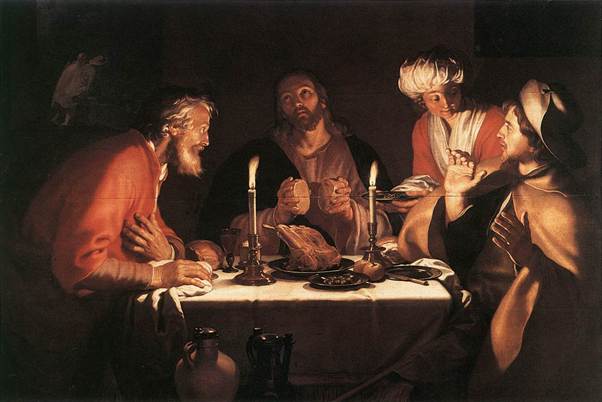
The Emmaus Disciples, Abraham Bloemaert, 1622[1]
In today’s gospel (John 12) Jesus tells us: “I came into the world as light, so that everyone who believes in me might not remain in darkness”. One of the main effects of Easter is joy, and joy can be translated into light. Light expels darkness, the darkness of sin and, therefore, the darkness of sadness.
One of the main Paschal narrations is the story of the disciples of Emmaus which we enjoyed hearing on the Third Sunday of Easter. It condenses the evangelical spirit, that is, what can be more enlightening that the Risen Lord walking, talking and dining with his disciples?
Hearts at Easter
As I was going through the Easter liturgical excerpts I connected two which spoke of the Easter hearts, or should I say, of hearts at Easter…? Then it dawned on me that hearts can be the eyes of the soul when it comes to faith, since faith is the substance of the things we hope for and the assurance of what we do not see (Hb 11: 1). Our hearts do see sometimes better than our eyes. In fact the disciples of Emmaus overwhelmed by sadness had eyes that did not see but then they remembered that their hearts were burning… and they saw.
Hearts had an essential role to play at Emmaus (Luke 24) as we know by the contrast: “Oh, how foolish you are! How slow of heart to believe all that the prophets spoke!” But later “they said to each other, “Were not our hearts burning within us while he spoke to us on the way and opened the Scriptures to us?” So they set out at once and returned to Jerusalem…”
Cut to the Heart
A few days ago in the Acts of the Apostles (chapter 2) we heard that Peter stood up with the Eleven, raised his voice, and proclaimed: “Let the whole house of Israel know for certain that God has made both Lord and Christ, this Jesus whom you crucified.” The text continues: “Now when they heard this, they were cut to the heart, and they asked Peter and the other apostles, “What are we to do, my brothers?” Peter said to them, “Repent and be baptized, every one of you, in the name of Jesus Christ for the forgiveness of your sins; and you will receive the gift of the Holy Spirit”.
Transformation of the Heart
In both cases, Emmaus and Acts, the shock or distress of the listeners with their hearts burning or they being cut to the heart, experienced a deep transformation. And that is exactly what Easter is all about: a transformation of the heart. The Israelites listening to Peter were converted and baptized after being cut to the heart. They repented and their sins were forgiven in the name of Jesus and they received the Holy Spirit. The two of Emmaus listened to the Scriptures explained to them by the Lord himself, unrecognized first, that is “unconverted” but their eyes opened when He, in a gesture that prefigures the Mass, broke the bread for them. Today, at Mass He continues to explain the Scriptures to us so that our hearts can burn and He breaks the Eucharistic Bread for us. If we listen carefuly we will be cut to the heart. Yes, the Risen Christ opens our eyes, then we can say as in today’s gospel that He came into the world as Light for our eyes, our hearts and our souls. He who is Light has transformed our darkness.
May the Paschal experience be one of transformation, joy, burning faith and Light for each one os us.
Happy Easter!
God bless you all,
Fr. Marcelo Javier Navarro Muñoz, IVE
Author: The Contribution of Cornelio Fabro to Fundamental Theology. Reason and Faith, Cambridge Scholars Publishing: https://www.cambridgescholars.com/product/978-1-5275-9315-2
Poesía Sacra, Quemar las Naves, and Desde Fossanova, IVE Press: https://ivepress.org/
[1] https://en.wikipedia.org/wiki/Road_to_Emmaus_appearance, 26 April 2026.