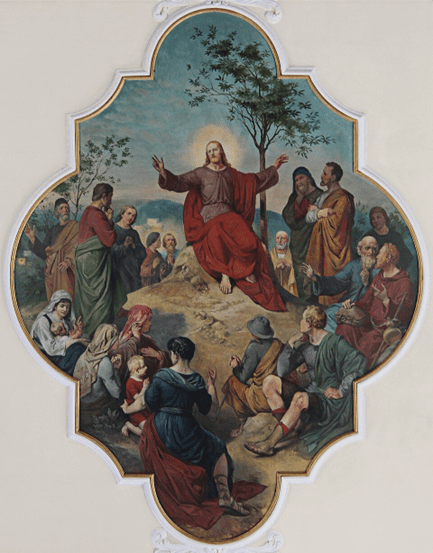
Sermon on the Mount (Christian Baer, 1909)1
A lamp to my feet is your word, a light to my path. (Ps 119: 105)
We are still at the very beginning of the liturgical cycle. The transition from Christmas up to this coming fourth week in Ordinary Time, Cycle A, has been smooth. We almost feel as if the Christmas liturgy of light was floating in the air. After the celebration of the Baptism of Christ which officially closes the Christmas season, we encountered John the Baptist and our Lord a second time, in which the Baptist introduced Jesus as the Lamb of God, the one who takes away the sin of the world. By using the image of the Lamb, he referred to the most important sacrifice of the Old Testament, where a lamb was offered twice daily in the temple. Christ is the new Lamb due to his innocence and meekness.
Light
It is quite obvious that each liturgical year concentrates on the mystery of Christ that unravels in front of our eyes with every eucharistic celebration. There is an order. There is a progression. The peak is undoubtedly Holy Week culminating on Easter Sunday: the Cross and the Resurrection. In this progression, we have recently come across the idea of light. It is no surprise to find in the gospel our Lord Jesus Christ as the light of the world, an expression He applied to Himself.
Last Sunday we heard in Mathew’s gospel that Christ “left Nazareth and went to live in Capernaum by the sea, in the region of Zebulun and Naphtali, that what had been said through Isaiah the prophet might be fulfilled: Land of Zebulun and land of Naphtali, the way to the sea, beyond the Jordan, Galilee of the Gentiles, the people who sit in darkness have seen a great light, on those dwelling in a land overshadowed by death light has arisen”. The evangelist applied to Christ the prophecy from Isaiah 8.
At the Christmas Night Mass, we also heard Isaiah 9: “The people who walked in darkness have seen a great light; upon those who dwelt in the land of gloom a light has shone”. Christ the Light has come to stay; he has come to illumine us, and He will do so throughout the liturgical year because His Word is a lamp for our path. The image of the new light is present also from the moment in which Christ began his ministry: “Repent, for the kingdom of heaven is at hand”, a line that Matthew adds right after the prophecy of Isaiah about this light that has arisen.
Beatitudes
Finally, this coming Sunday, the fourth in Ordinary Time, we will hear the proclamation of the Beatitudes. The Catechism of the Catholic Church says that the Beatitudes “are at the heart of Jesus’ preaching… [and] fulfill the promises by ordering them no longer merely to the possession of a territory, but to the Kingdom of Heaven” (n. 1716). Also, “they shed light on the actions and attitudes characteristic of the Christian life” (n. 1717).
Christ is light. His words are light. The Beatitudes coming from his mouth are light to illumine our actions. Let us continue to live our eucharistic celebrations throughout the year with the desire to be always enlightened by Christ, our Light and our salvation.
God bless you all,
Fr. Marcelo Javier Navarro Muñoz, IVE
Author: The Contribution of Cornelio Fabro to Fundamental Theology. Reason and Faith, Cambridge Scholars Publishing: https://www.cambridgescholars.com/product/978-1-5275-9315-2 Poesía Sacra, Quemar las Naves, and Desde Fossanova, IVE Press: https://ivepress.org/
1https://commons.wikimedia.org/wiki/File:Deckenfresko_Unser_Lieben_Frauen_Lauben_16052015_(Foto_Hilarmont,_retuschiert).jpg, accessed January 27, 2026.